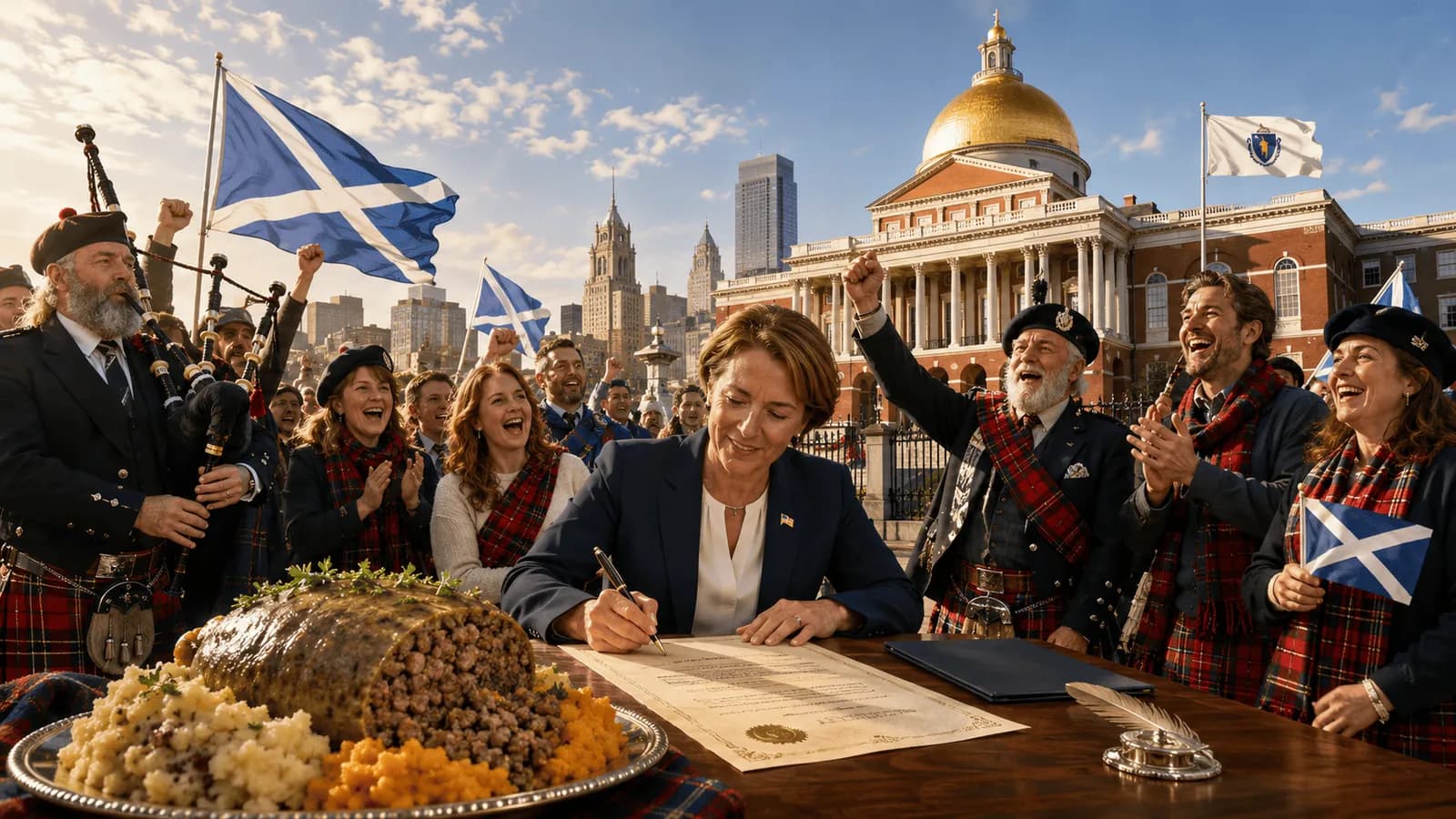
Massachusetts has just handed Scotland’s national dish one of the funniest near-victories in modern food politics.
Governor Maura Healey signed a symbolic executive order in Boston and declared that haggis had been made legal in Massachusetts. It was a brilliant line, a brilliant stunt, and a brilliant moment for Scotland’s travelling football supporters.
There was only one small problem: no actual law changed.
Traditional haggis remains blocked in the United States because federal food rules still prohibit livestock lungs from being used for human food. Since sheep’s lung is one of the ingredients in the traditional recipe, authentic haggis is still, officially, off the American menu.
But that is exactly why the story has travelled so far.
This is not really just about dinner. It is about Scottish identity, football, tradition, theatre, and the ability of the Tartan Army to turn almost any city in the world into a temporary Scottish outpost.
And in Boston, they have managed it spectacularly.
The Day Haggis Became Legal-ish
The Massachusetts moment was never a dry legal announcement. It was knowing, playful and full of Scottish mischief.
Scottish podcaster David McIntosh Jr helped push the issue into the spotlight, while Scotland fans in Boston turned the city tartan during the World Cup. The phrase “legalise haggis” suddenly had the perfect stage: thousands of Scots, a host city enjoying the chaos, and a governor happy to lean into the joke.
Massachusetts was already in the mood. The state has long recognised Scottish heritage through Tartan Day, and Governor Healey had publicly praised the visiting Scotland fans for the energy and enthusiasm they brought to the Commonwealth.
In other words, Boston was not suddenly discovering Scotland. It was welcoming it with open arms, a big smile and, apparently, ceremonial paperwork.
For Dundee readers, that matters. This was not some sneering “look at the funny Scottish food” moment. It was a warm, clever piece of cultural theatre in a city that had already decided the Scots were excellent company.
Massachusetts did not overturn Washington. It did not rewrite federal food law. But it did recognise something every Scot understands instinctively: haggis is never just a plate of food.
It arrives with noise, memory, poetry, argument, humour and usually a raised glass somewhere nearby.
The Rule That Still Says No
The real obstacle remains federal.
Under current US food rules, livestock lungs cannot be saved for use as human food. That is the bit that matters. Traditional haggis is usually made with sheep’s heart, liver and lungs, mixed with oatmeal, suet, onion and spices.
So when Scots say the American ban is really about the lungs, they are not being dramatic. They are being accurate.
That is also why the Massachusetts order was always symbolic. A state governor can create headlines, warm hearts and give campaigners a viral moment. What she cannot do is unwrite a federal rule that still blocks one of the defining ingredients of traditional haggis.
There are American-made alternatives, of course. Some versions leave out the lung and use extra heart or liver instead. They may be practical, and they may even taste perfectly good, but to many purists they are still a compromise.
A lung-free haggis may get around the rule. It does not quite get around the principle.
Boston Turned Tartan
The reason this story suddenly became global news is simple: Scotland’s World Cup return gave the campaign a marching band.
Scotland beat Haiti 1-0 in Boston in their first men’s World Cup appearance since 1998, with John McGinn scoring the winner. The result was big enough on its own, but the scenes around the city gave the story another life entirely.
Boston was not just hosting Scotland. It was being temporarily adopted by Scotland.
There were kilts, bagpipes, songs, fan walks, packed bars and the kind of cheerful disruption that only the Tartan Army can really deliver. Reuters reported that some Boston bars had to arrange emergency beer deliveries after being pushed close to the limit by thirsty Scottish supporters.
That may be the most Scottish sentence ever written about American hospitality.
The city appeared to love it. Boston Mayor Michelle Wu praised the visiting fans for supporting local businesses and treating Boston like a home away from home. Once a city has warmed to the kilts, the bagpipes and the spending power, it does not take much for haggis to move from obscure food-regulation issue to civic talking point.
Massachusetts had already changed hospitality rules for the World Cup summer, allowing some bars to stay open later and permitting temporary public drinking areas in certain places. So by the time haggis entered the chat, the Commonwealth was already in the business of making room for football chaos.
The symbolic haggis order fitted the mood perfectly.
Why the Campaign Has Suddenly Found Its Voice
The push to legalise haggis in the United States did not come from nowhere.
Scottish butcher Simon Howie had already launched a “Make Haggis Legal Again” campaign ahead of the World Cup, arguing that travelling Scotland supporters were heading to America without proper access to their national dish.
That campaign works because it understands the issue is not purely culinary. It is emotional.
Haggis is one of those foods that carries more meaning than its ingredients list suggests. It is eaten, joked about, defended, recited over and carried into Burns Suppers with almost comic seriousness. It is both meal and mascot.
That is why the World Cup was the perfect moment for the campaign. Nobody in Boston was in the mood for dry regulatory debate. They were in the mood for songs, flags, beer, football and big gestures.
Suddenly, a technical food rule became a pub conversation.
If America can handle kilts, bagpipes, whisky, chants and thousands of Scots drinking Boston dry, can it really not handle one sheep lung?
Why Dundee Should Enjoy This
For Dundee and the wider Scottish audience, the real pleasure here is not simply that haggis made headlines. It is how it made headlines.
This was haggis doing what haggis does best: causing a fuss, making people laugh, and somehow becoming more beloved every time someone tries to explain it too seriously.
Burns called it the “great chieftain o’ the puddin’-race”, and more than two centuries later it is still being piped into rooms, toasted at suppers, served with neeps and tatties, and defended like a national treasure.
That is why the Massachusetts story lands so well. It is funny, but it is not meaningless. It shows how Scottish culture travels, how football fans can reshape a city’s mood, and how even a symbolic political gesture can make a national dish feel newly relevant.
So no, Massachusetts has not truly legalised traditional haggis.
The federal ban still stands.
But Boston has done something almost as useful in the age of spectacle: it has made haggis visible, debatable and funny all over again.
Scotland went to Boston, won a World Cup match, tested the city’s beer supply, charmed the locals and somehow turned a paragraph of American meat-inspection law into international cultural theatre.
That is an outstanding away performance.
