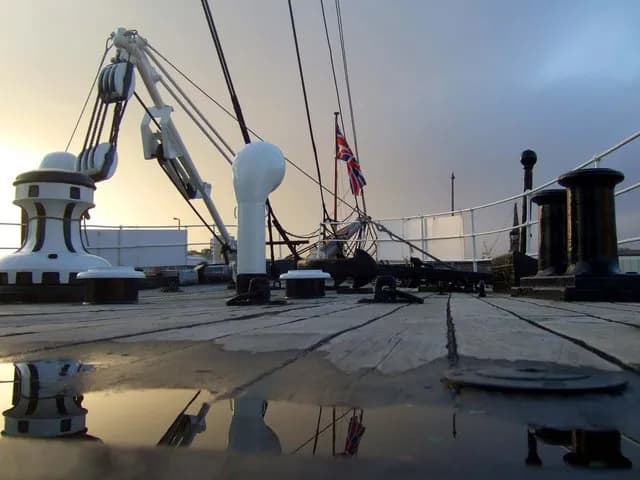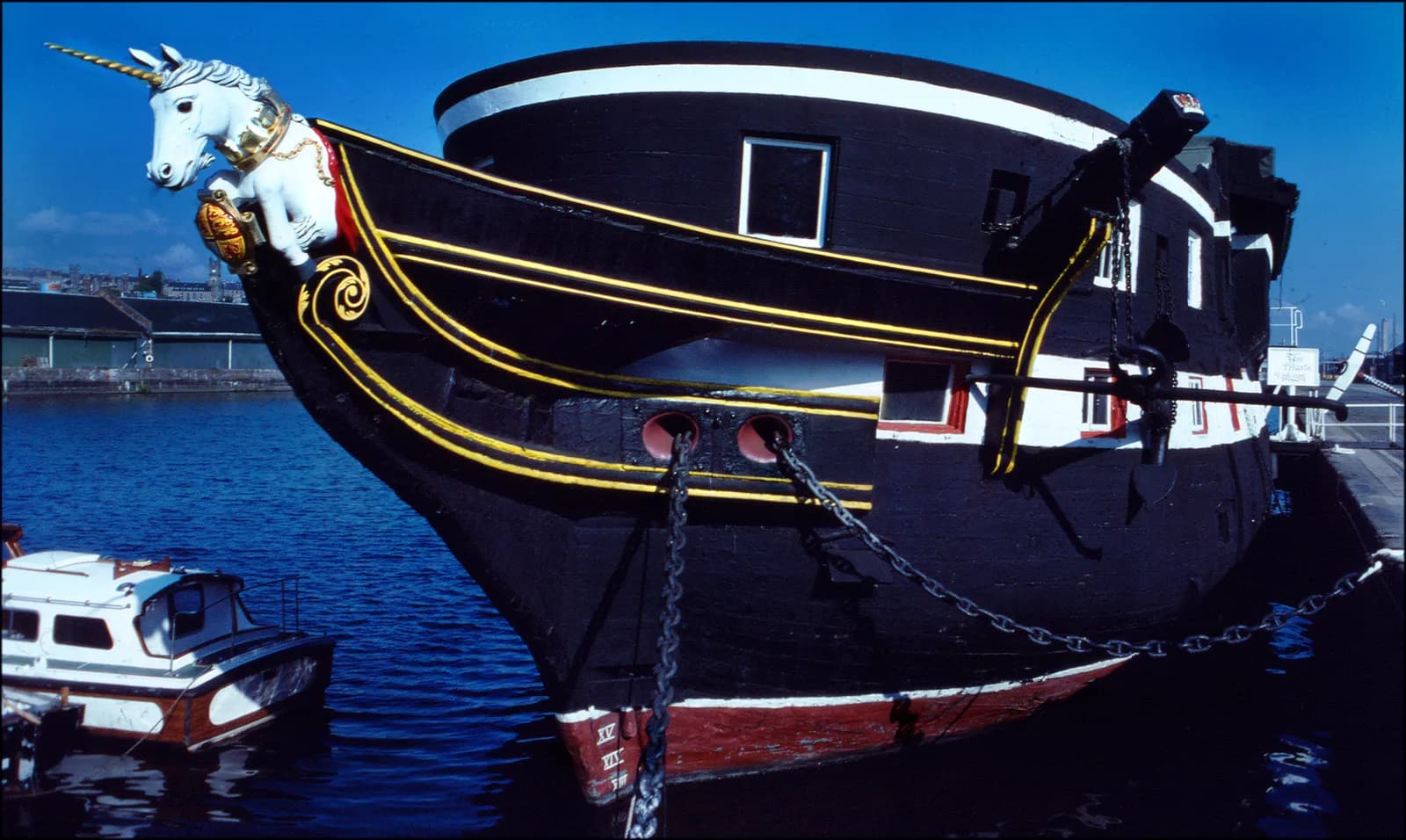
HMS Unicorn, the oldest ship in Scotland and one of only six oldest vessels still afloat worldwide, faces an urgent battle for survival. A 2021 survey revealed extensive rot in the frigate's planking, prompting a £10 million fundraising campaign to secure its future.
A Georgian Survivor
Ordered in 1817 and launched at Chatham Dockyard on 30 March 1824, HMS Unicorn was built as a 46-gun modified Leda-class frigate to a design by Sir Robert Seppings, Surveyor of the Navy. Unlike her sister ships, she never received masts nor saw active service; instead, she was placed immediately into reserve with a protective roof fitted over her deck. This stroke of fortune preserved her fabric remarkably. The vessel retains an estimated 90 to 95 per cent of her original Georgian construction, earning her recognition by maritime historians as "the most original old ship in the world."
The frigate arrived in Dundee in November 1873, towed north by HMS Salamander to serve as a drill ship for the Royal Naval Reserve. She replaced HMS Brilliant and would remain on the Tay for nearly a century, training hundreds of recruits who served in the First World War and over 1,500 women of the Women's Royal Naval Service during the Second World War. During the Second World War, she served as Area Headquarters for the Senior Naval Officer, Dundee, and accepted the surrender of German submarine U-2326 on 14 May 1945. Renamed HMS Unicorn II and later HMS Cressy during the war years to avoid confusion with a new aircraft carrier, she resumed her original name in 1959.
The Conservation Crisis
A structural survey conducted in March 2021 delivered sobering findings. Shipwright Dominic Mills examined the vessel and concluded that "most of the planking is in a very poor state." Even planking dating from the 1850s showed extensive rot. Mills warned that the ship required dry-docking or repair "sooner rather than later," noting that the decay was compromising the overall structure. Despite these challenges, Mills emphasised the vessel's extraordinary significance: "Virtually all of what you see dates back to the day it was built and it hasn't been largely rebuilt over that time. It really is a fantastic ship."
The survey findings prompted urgent action from the Unicorn Preservation Society, the charitable trust that has stewarded the vessel since 1968. In 2023, a temporary plastic-steel coated roof was fitted to make the structure watertight while longer-term plans were developed. Structural reinforcement work on the hull is currently ongoing.
Project Safe Haven
The Unicorn Preservation Society has launched Project Safe Haven, an ambitious plan to secure the frigate's future. The project comprises four key aims: protecting the ship through essential repairs, relocating her to the refurbished East Graving Dock, constructing a new dockside visitor centre, and expanding community engagement. The total project cost is estimated at £10 million.
Significant funding has already been secured. In July 2023, the society received £1.11 million from the National Heritage Memorial Fund, which executive director Matthew Bellhouse Moran described as "game changing." In January 2025, the National Lottery Heritage Fund awarded £796,000 in first-round development funding. Additional grants include £221,860 and £250,000 awarded in August 2024, plus £100,000 from the Headley Trust in 2023.
However, the society faces a critical deadline. It must raise an additional £650,000 by April 2025 to unlock further funding, including a £3.3 million second-round National Lottery Heritage Fund award and Tay Cities Deal support. Bellhouse Moran issued an urgent appeal in January 2025: "We urgently need the support of individuals, businesses, and organisations to raise the finance needed for the next stage of Project Safe Haven... the clock is ticking."
Dundee's Maritime Heritage
HMS Unicorn holds a unique place in Dundee's built heritage. She has been a feature of the waterfront for 150 years, longer than the first Tay Rail Bridge (1878), the McManus Galleries (1867), and Caird Hall (1914-1923). The ship predates much of the city's Victorian and Edwardian architecture, yet remains relatively unknown compared to other historic vessels such as HMS Victory or the Mary Rose.
Lady Catherine Erskine, chair of the Unicorn Preservation Society, has championed greater recognition for the vessel. In 2021, she noted: "She's up there with those ships, but unknown, and a feature of Dundee for many many years." Erskine expressed hope that moving Unicorn to dry dock in time for her 200th anniversary would be "the best birthday present" the city could give.
The society has appealed for gifts of large oak trees to help replace the rotting planking. In November 2022, HMS Unicorn won the Martyn Heighton Award for Excellence in Maritime Conservation at the National Historic Ships UK Awards. The Princess Royal, who serves as patron of the Unicorn Preservation Society, visited the ship in 2025 to mark a new era for Project Safe Haven.
A Floating Time Capsule
What distinguishes HMS Unicorn from nearly every other historic vessel is her authenticity. While most ships of comparable age have undergone extensive reconstruction, Unicorn remains essentially as built. Her survival represents a remarkable accident of history; placed in reserve immediately after launch and protected by her roof, she escaped the decay and modification that claimed her contemporaries.
The ship currently lies berthed in Victoria Dock, Dundee, open to the public as a museum. Visitors can explore her decks and experience a rare glimpse of Georgian naval architecture. Her visitor book, begun in 1926, contains signatures from King George VI, Queen Elizabeth, King Haakon of Norway, and General Sikorsky.
With only one other Leda-class frigate surviving, HMS Trincomalee in Hartlepool, Unicorn represents an irreplaceable piece of maritime history. Whether Project Safe Haven succeeds in securing her future will depend on the next few months of fundraising. For Dundee, the stakes extend beyond heritage conservation; the ship represents 150 years of local maritime tradition and the training ground for generations of naval reservists. Her loss would diminish not only Scotland's historic environment but the city's sense of itself.